
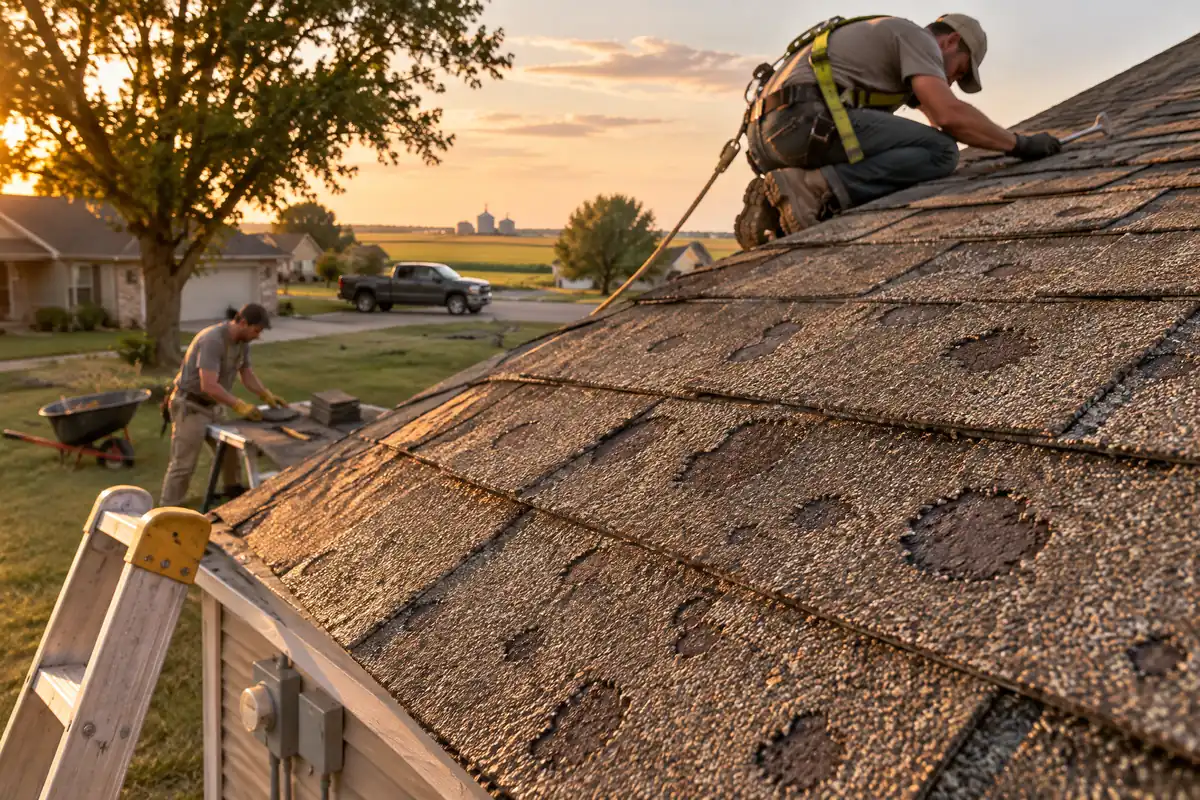
Why does Wichita get so much hail damage?
South-central Kansas is where warm, moist air from the Gulf meets dry air coming off the high plains, and that collision builds the tall supercell thunderstorms that produce large hail. The Wichita metro has a long record of damaging hailstorms. On September 15, 2010, baseball-size or larger hail fell across the area and led to more than 35,000 insurance claims, according to the National Weather Service in Wichita. In 2025 the Kansas Insurance Department counted $879 million in storm claims statewide, with Sedgwick County responsible for $383 million after an early September storm dropped hail up to 2.75 inches. As recently as April 25, 2026, the Weather Service logged 1.5 to 1.75 inch hail in both east and west Wichita.
In other words, a roof here is likely to take a direct hit at some point. The question is when, and whether the damage gets caught early.
What does hail actually do to a roof?
- Granule loss. The colored granules that shield asphalt from UV get knocked away, leaving dark round marks. Exposed asphalt breaks down faster in the sun.
- Bruising and mat fractures. A hard hit can crack the fiberglass mat inside a shingle while the surface looks almost normal. It feels soft, like a bruise on fruit.
- Cracked or split shingles. Older, brittle shingles can split clean through.
- Damaged metal. Dents in ridge vents, turtle vents, gutters, downspouts and flashing are often the easiest sign to spot.
- Broken seals. Wind with the hail can unseal shingle tabs so they lift in the next storm.
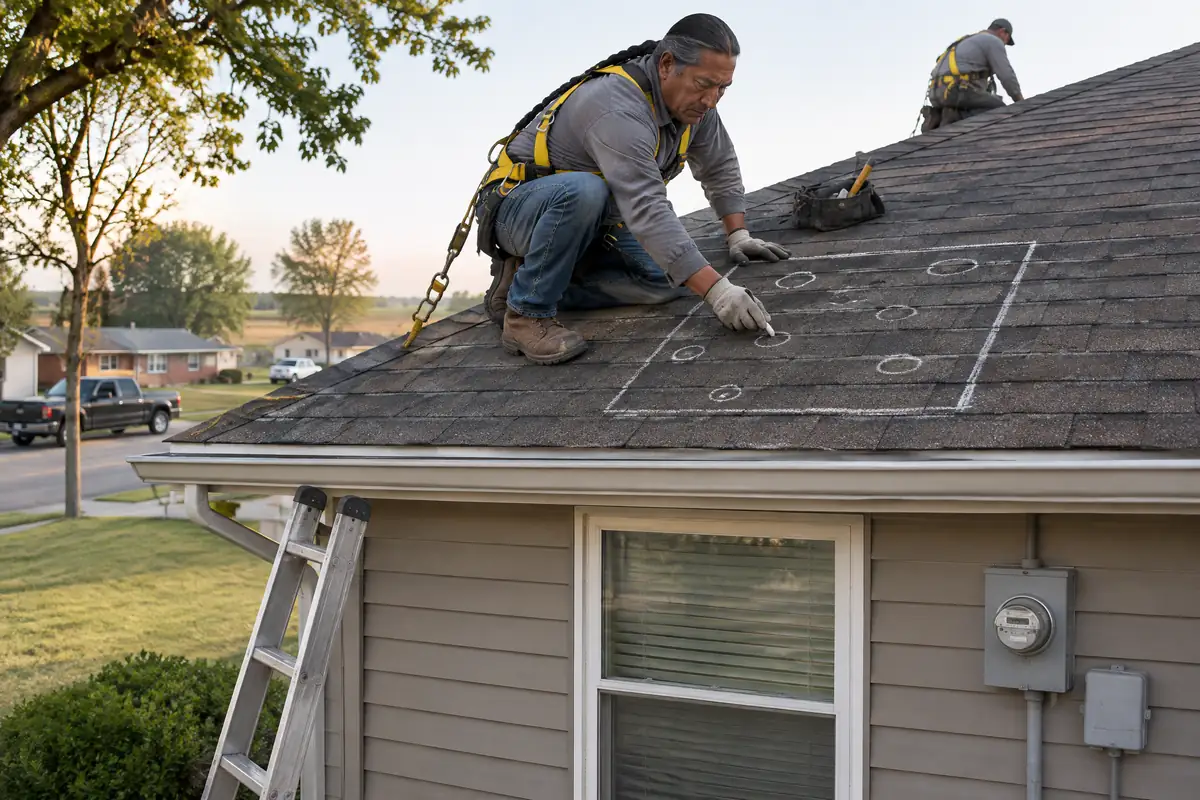
How is hail damage inspected and repaired?
A roofer walks each slope and usually marks out test squares, often ten feet by ten feet, counting hits on each one. They photograph the hits, the dented soft metals and the collateral damage on gutters, siding and window screens. That record is what you and your adjuster work from.
If the damage is confined to one slope or a few spots, a repair may be enough. If hits are spread across most slopes, the usual outcome is a full roof replacement, because new shingles patched into a damaged roof do not restore the rest of it.
How do insurance policies treat hail damage?
Every policy is different, so read yours. These are the terms that come up most often on Kansas hail claims:
| Actual cash value (ACV) | Replacement cost value (RCV) | |
|---|---|---|
| What it pays | Cost to replace, minus depreciation for the roof's age | Cost to replace with like kind and quality |
| Older roofs | Payout can be far below the cost of a new roof | Payout tracks the real cost, often in two checks |
| Your share | Deductible plus the depreciation gap | Deductible |
| Common on | Older roofs and some budget policies | Many standard homeowner policies |
Watch for a separate wind and hail deductible, which is sometimes a percentage of your dwelling coverage rather than a flat amount, and for cosmetic damage exclusions that limit payment for dented metal. Our Kansas roof insurance claim guide walks through the process step by step.
What should you do right after a hailstorm?
- Wait until the storm has fully passed and lightning has stopped.
- From the ground, photograph gutters, downspouts, window screens, the air conditioner fins and any hailstones next to a coin or ruler.
- Note the date and time of the storm.
- Check ceilings and the attic for water.
- Call for an inspection, and let your insurer know about the loss within the time your policy requires.
Our after-hail checklist has more detail on what to look for safely.
When is hail damage an emergency?
When hail has punched through the roof, broken a skylight or let water into the house. Then the priority is keeping more water out with a tarp or temporary patch, which most insurers expect you to do to prevent further damage. Keep receipts for any emergency work. See emergency roof repair.
Questions people ask
What size hail damages a roof?
There is no single cutoff. Hail around one inch, roughly quarter size, can bruise older asphalt shingles, and larger stones can crack or puncture newer ones. Wind, shingle age and the angle of impact all matter, which is why an inspection beats guessing from the size alone.
How soon after a hail storm should I get my roof inspected?
As soon as it is safe. Policies usually require prompt notice of a loss, and the reporting window varies by insurer, so check yours. Early documentation also makes it easier to show the damage came from a specific storm.
Can hail damage a roof without causing a leak?
Yes, and it often does. Hail can crack the shingle mat or knock off the protective granules without letting water in right away. The leaks tend to show up months later, after the damage has been through more sun and freeze cycles.
Will insurance replace my whole roof after hail?
That depends on how much damage the adjuster finds, your policy terms and your deductible. Some policies pay actual cash value, which subtracts depreciation, and some exclude cosmetic damage to metal. Our insurance claim guide explains the common terms.
Should I sign with the first roofer who knocks on my door after a storm?
Take your time. Out-of-town crews often follow big Wichita storms. Check the Kansas Attorney General's roofing registration directory, ask for proof of insurance and a local address, and read anything before you sign it.