
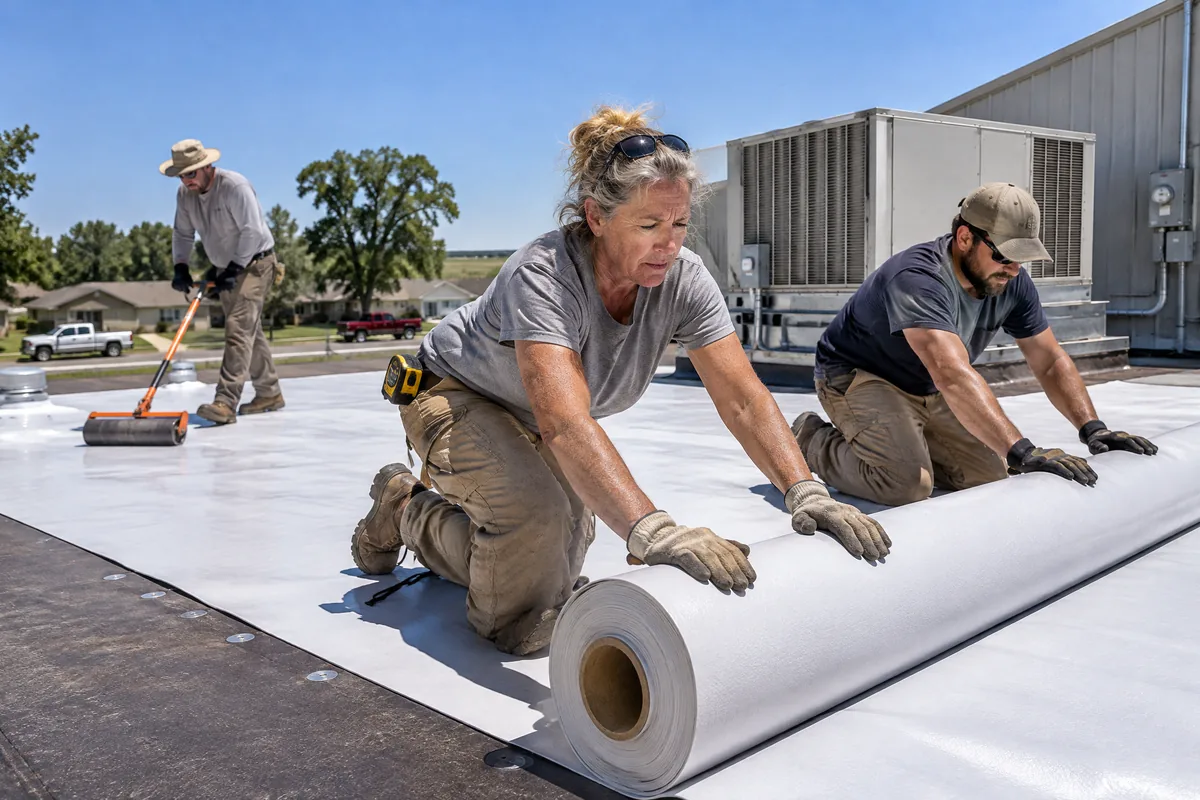
Which buildings does commercial roofing cover?
Wichita has a lot of low-slope roof area: aviation suppliers and machine shops along the industrial corridors, strip centers on Rock Road and Kellogg, churches, schools, medical offices, and older apartment buildings with flat or near-flat roofs. Many homes also have a low-slope section over a porch, carport or addition that uses the same materials. Roofers in our network handle both the large membranes and the small residential flat sections.
What are the signs a flat roof needs work?
- Water still standing on the roof two days after rain.
- Blisters, bubbles or wrinkles in the membrane.
- Seams that have opened or flashing pulling away at walls, curbs and skylights.
- Stains on ceiling tiles, especially near rooftop units and drains.
- Cracked or alligatored surfaces on older built-up and modified bitumen roofs.
- Punctures or dents after hail, which are easiest to spot on rooftop units and metal trim.
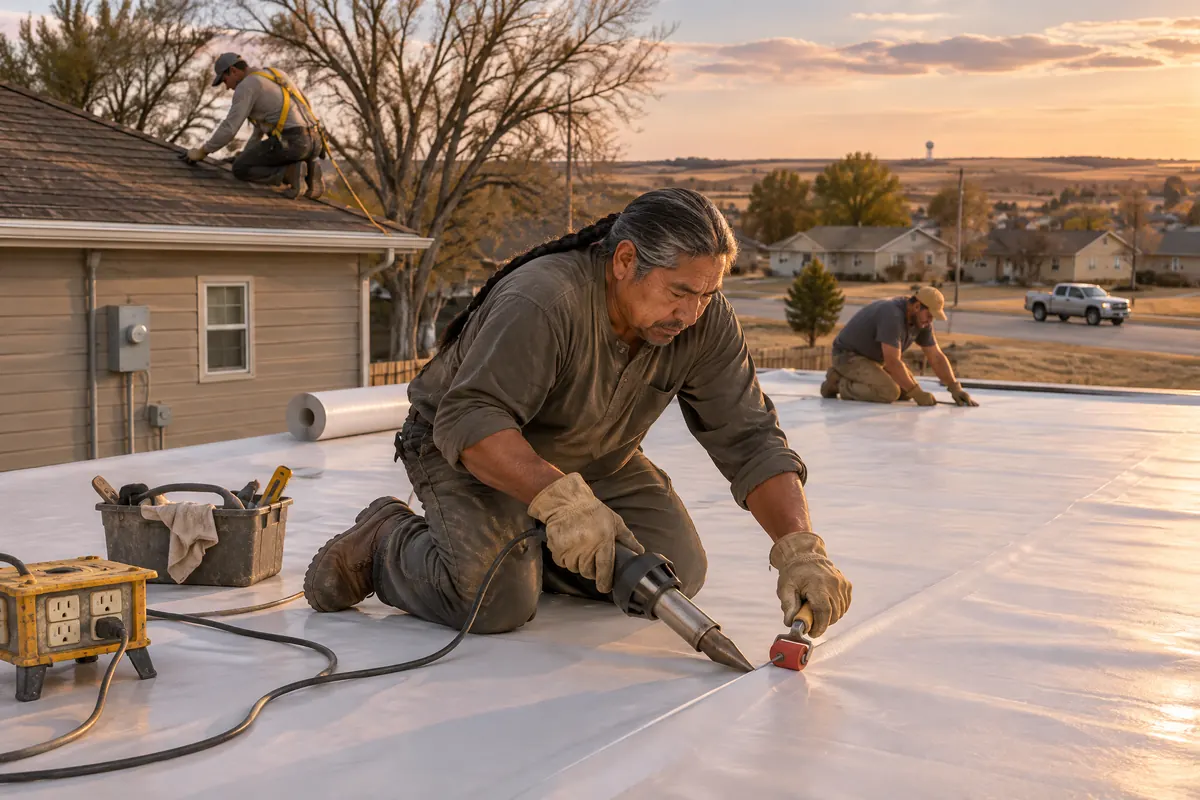
Which flat roof system is right for your building?
| System | What it is | Strengths | Watch for |
|---|---|---|---|
| TPO | Single-ply thermoplastic sheet, seams heat-welded | Reflective white surface, strong welded seams | Quality varies by manufacturer and thickness |
| EPDM | Single-ply synthetic rubber, seams taped or glued | Long track record, flexible in cold | Black versions absorb heat; seams need care |
| Modified bitumen | Asphalt-based rolls, torched or self-adhered | Tough against foot traffic | Heavier; torch-down needs fire safety |
| Roof coatings | Liquid-applied silicone or acrylic over a sound roof | Extends life of an aging roof | Not a fix for wet insulation underneath |
How is commercial roof work carried out?
Good commercial work begins with finding out what is under the surface. A roofer may take core cuts or use infrared or moisture meters to map wet insulation, because a membrane that looks fine can be sitting on a soaked board. From there the options are repair, coating, recover or full tear-off. The roofer will also look hard at drainage: drains, scuppers and tapered insulation that moves water off the roof are often more important than the membrane itself.
What affects the cost of commercial roofing?
- Roof area, number of layers and how much wet insulation must be removed.
- The system chosen and its thickness, plus insulation needed to meet energy code.
- Rooftop equipment that has to be lifted or flashed around.
- Access, crane time and work-hour restrictions at occupied buildings.
- Permit and plan-review requirements.
Ask for proposals that state the system, membrane thickness, insulation and warranty type so you can compare like with like.
How should a property manager prepare?
- Gather roof age, past repair records and any manufacturer warranty paperwork.
- Mark known leak spots inside, with photos.
- Plan tenant notices, parking areas for equipment and protected entrances.
- Confirm who carries the risk if rooftop units need to be disconnected.
When is a commercial roof leak an emergency?
When water is reaching electrical panels, server rooms, inventory or occupied space, or when wind has peeled back part of the membrane. A roofer can usually make a temporary seal or install a temporary cover. Document everything for your insurer, and see our roof insurance claim guide for what the adjuster will want.
Questions people ask
How long does a flat roof last in Wichita?
It varies widely with the system, installation quality, drainage and maintenance. Ponding water, foot traffic around rooftop equipment and hail all shorten the life of a membrane. Twice-yearly inspections help catch problems early.
Can a flat roof be repaired instead of replaced?
Often. Punctures, open seams and failed flashing at curbs and drains can be repaired. If a moisture survey finds wet insulation across large areas, replacement or a recover is usually more cost-effective.
Is it possible to keep the building open during roof work?
Usually, yes. Commercial roofers commonly work in sections and plan around business hours, entrances and deliveries. Discuss staging, crane access and noise before the job starts.
What is a roof recover?
A recover installs a new membrane over the existing roof, often with a cover board, instead of tearing everything off. Codes limit how many roof layers a building can have, and wet insulation underneath has to be removed first.
Do commercial roofs in Wichita need permits?
Most reroofing does. MABCD handles permits in Wichita and unincorporated Sedgwick County, suburbs run their own permit desks, and commercial projects can involve plan review. Your roofer should pull the permit.