
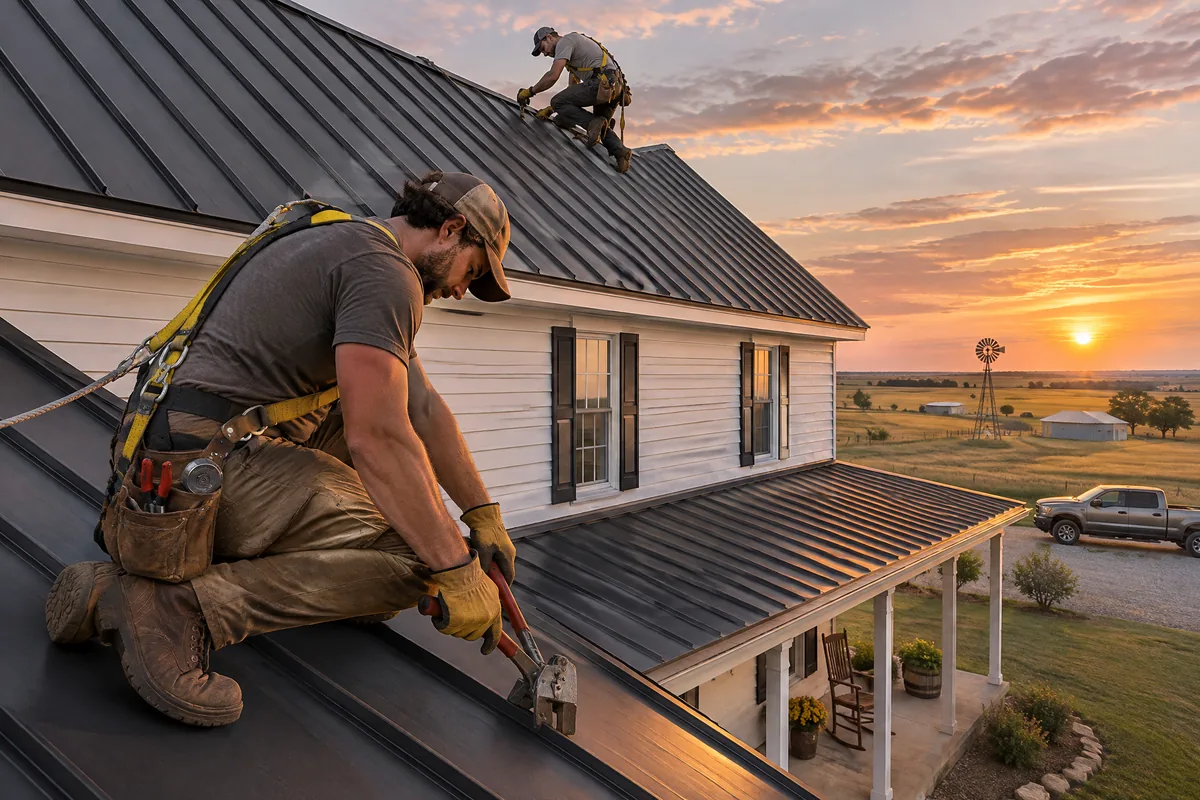
Why do Wichita homeowners choose metal roofing?
Mainly because of the storms. After a second or third hail claim, many owners start asking whether there is a roof that will not need replacing every time a supercell rolls in from the west. Metal is the usual answer. It is also common on the farm buildings, shops and pole barns that sit on acreages around Maize, Goddard, Valley Center and Rose Hill, where a single roofer can often handle both the house and the outbuildings.
Beyond hail, metal handles wind well when installed with the right fastening pattern, sheds snow quickly, and reflects more summer heat than dark shingles, especially with a light or coated finish.
Which type of metal roof fits your home?
| Style | How it is fastened | Best for | Maintenance |
|---|---|---|---|
| Standing seam | Hidden clips under raised seams | Homes, long-term owners | Low |
| Exposed-fastener (ribbed) panels | Screws through the panel face | Barns, shops, budget projects | Check screws and washers every few years |
| Stone-coated steel | Interlocking pieces | Homes wanting a shingle or shake look | Low |
| Metal shingles | Interlocking, hidden fasteners | Neighborhoods with style rules | Low |
Steel is by far the most common metal used on Kansas homes. Thicker panels, which carry a lower gauge number, resist dents better and cost more.
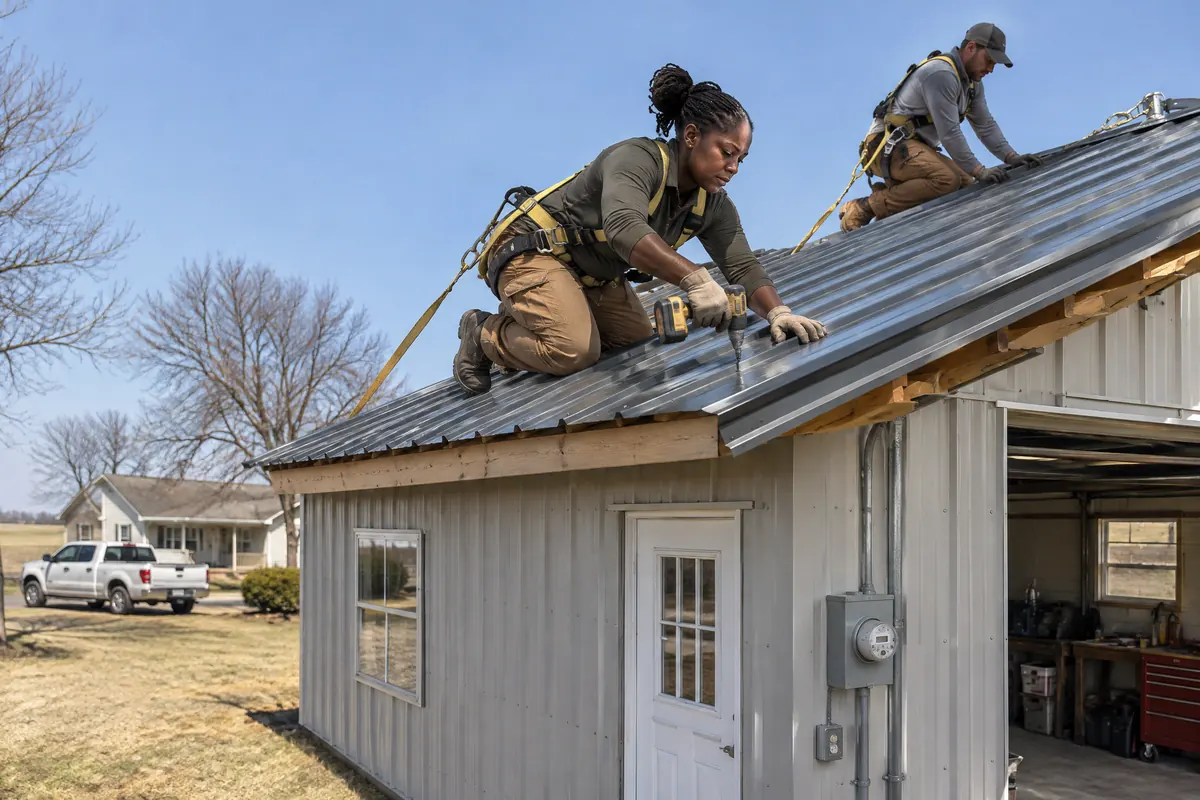
How is a metal roof installed?
On a house, the old roof usually comes off first so the deck can be checked. Then the crew lays a high-temperature synthetic underlayment, because metal gets hotter than shingles in a Kansas July. Panels are measured and often cut or formed to length, then fastened from one end of the roof to the other with trim at the eaves, rakes, valleys and ridge. Details at chimneys, skylights and vent pipes take the most care, since they are where metal roofs leak if done carelessly.
What affects the cost and timeline?
- Panel style and gauge. Standing seam costs more than exposed-fastener panels. Thicker steel costs more than thinner.
- Roof complexity. Every valley, hip and dormer adds trim and labor.
- Tear-off. Removing shingles and repairing decking adds time.
- Color and coating. Premium paint systems hold color longer in strong sun.
- Gutters and snow guards. These are often quoted alongside the roof.
A typical home takes several days, longer than a shingle roof, because the panels and trim are fitted piece by piece.
How should you prepare for a metal roof installation?
- Ask your insurance agent how a metal roof changes your premium and whether cosmetic damage is excluded.
- Check any HOA rules about roof materials and colors.
- Clear space for panel delivery, which can be long lengths on a flatbed.
- Plan for noise during tear-off, the same as any reroof.
When does a metal roof need urgent attention?
Call promptly if a storm has lifted a panel edge or a piece of trim, if screws have backed out and water is getting in, or if a tree has creased a panel. A loose panel can catch the wind and tear off more of the roof in the next storm. For barns and shops, check after every big wind event, because exposed-fastener roofs are the ones most likely to lift.
Questions people ask
Does hail ruin a metal roof?
Large hail can dent metal panels, but it rarely punctures them the way it can crack shingles. Thicker gauges and textured finishes show dents less. Many Kansas policies limit payment for dents that are cosmetic only, so check yours.
Is a metal roof loud in a Kansas storm?
Over a solid deck with underlayment and attic insulation, most homeowners find it little louder than shingles. Metal fastened over open purlins on a barn or shop is much louder.
Can metal go over my existing shingles?
Sometimes, depending on local code and the condition of the deck. Many roofers prefer a tear-off so they can check and repair the decking first. Ask what your town's building department allows.
What is the difference between standing seam and exposed-fastener metal?
Standing seam hides its fasteners under raised seams, which allows the panels to expand and contract and needs less maintenance. Exposed-fastener panels are screwed through the face, cost less, and need the screws and washers checked over time.
Do metal roofs attract lightning?
No. Metal does not make a strike more likely, and if lightning does hit, metal is non-combustible and spreads the charge. A lightning protection system is a separate choice.