
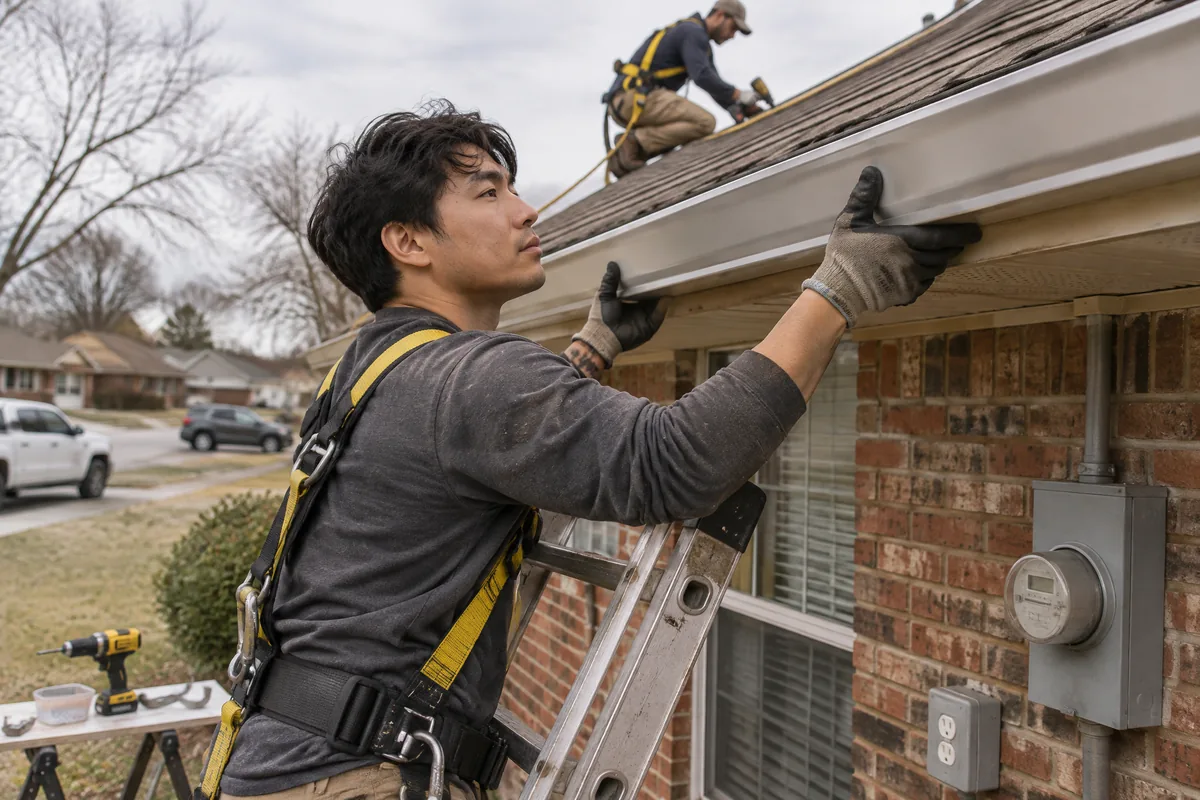
Why do gutters matter so much in Wichita?
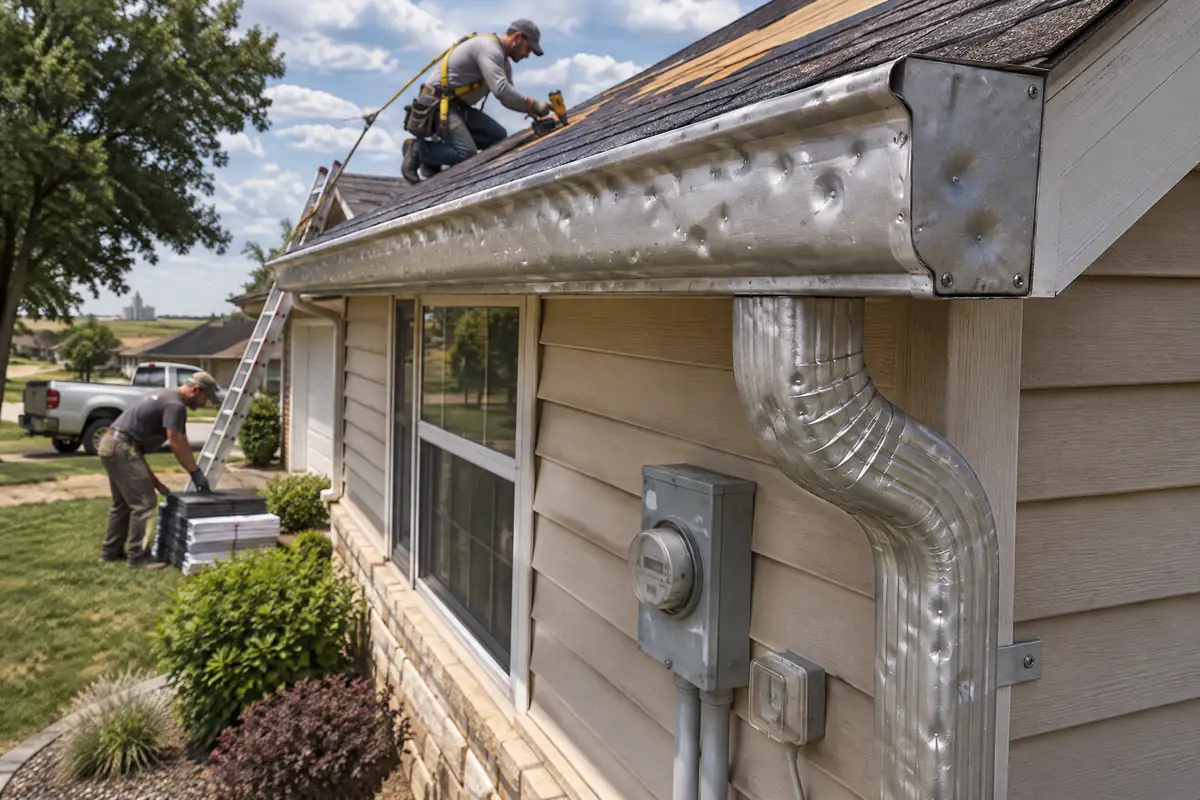
Kansas storms dump a lot of rain in a short time. Without gutters that can handle it, water pours off the eaves straight next to the foundation, where it soaks the soil, can push into basements and crawlspaces, and splashes back onto siding and windows. Gutters also take a beating in hail. Dented aluminum is one of the clearest signs a storm was strong enough to damage the roof above it.
What are the signs your gutters need repair or replacement?
- Overflowing during heavy rain, even after cleaning.
- Sagging sections or gutters pulling away from the fascia.
- Leaking seams and corners, or rust streaks on older steel gutters.
- Dents and creases after hail.
- Peeling paint, rot or stains on the fascia board behind the gutter.
- Erosion, puddles or mulch washed away under the eaves.
- Piles of shingle granules collecting in the gutter, which also tells you about the roof.
Which gutter type should you choose?
| Sectional | Seamless | |
|---|---|---|
| How it is made | Pre-cut lengths joined together | Formed on site to the exact length of each run |
| Joints | Every 10 to 20 feet | Only at corners and downspouts |
| Leak risk | Higher, as joint sealant ages | Lower |
| Typical material | Vinyl, aluminum or steel | Aluminum, sometimes copper or steel |
| Install | DIY possible | Professional with a forming machine |
How are new gutters installed?
The installer measures each run, checks the fascia for rot and replaces any soft boards first. A truck-mounted machine then forms seamless aluminum gutter from a coil to the exact length. Hangers are fastened into the rafter tails or fascia at close spacing so the gutter holds up under ice and heavy water. Each run is pitched toward its downspouts, outlets are cut, corners are sealed, and downspouts are fitted with extensions or splash blocks that send water well away from the foundation.
What affects the cost and time?
- Total length of gutter and the number of corners and downspouts.
- Gutter size (5-inch or 6-inch) and metal thickness.
- Removal and disposal of the old system.
- Fascia or soffit repairs found when the old gutters come off.
- Guards, larger downspouts or underground drain connections.
- Second-story height and access.
Most single-family homes are finished in a day or less once the job is scheduled.
How should you prepare for gutter work?
- Move vehicles, grills and patio furniture away from the eaves.
- Trim back shrubs crowding the walls so ladders can be set safely.
- If you are also replacing the roof, ask whether to schedule the gutters right after, so new drip edge sits correctly.
- If you are filing a hail claim, photograph dented gutters before anything is removed.
When is a gutter problem urgent?
When a section has torn loose and is hanging over a walkway or driveway, or when water pouring off the roof is flooding a basement window well. Those need attention before the next storm. Otherwise, gutter work can usually be scheduled along with any roof repair. If hail dented your gutters, read our after-hail checklist and get the roof checked too.
Questions people ask
Are seamless gutters worth it?
For most homes, yes. Seamless gutters are formed in one piece for each run, so the only joints are at corners and downspouts. Fewer joints means fewer places to leak or collect debris.
Should gutters be replaced at the same time as the roof?
It often makes sense. Hail that damages a roof usually dents the gutters too, and replacing both together lets the roofer install new drip edge properly behind the gutter.
Do I need 5-inch or 6-inch gutters?
Many homes use 5-inch, but larger or steeper roofs and long runs can overwhelm them in a Kansas downpour. Six-inch gutters with larger downspouts carry noticeably more water. Ask the installer to size them to your roof.
Do gutter guards stop all cleaning?
No guard is maintenance-free, but good ones cut down on leaves and debris a lot. In older Wichita neighborhoods with big trees, they can save several ladder trips a year.
Why are my gutters overflowing in heavy rain?
Usually a clog, too few downspouts, too little slope, or gutters too small for the roof area. A roofer can check the pitch and sizing.